Osmian
New Life as a Max Level ArchmageOsmian is the legendary founder of the Thaumaturgical Institute and a former Headmaster whose presence survives through a fortified door, a ghostly vessel, and an uncompromising succession ritual. His appearance gives Vivisari Vexaria access to a figure who belongs simultaneously to history, institutional memory, and active magical inquiry. Through him, the Institute’s celebrated past becomes an unresolved conversation about dimensional magic, soul fragments, inheritance, and the danger of preparing too late for the next Cataclysm.
Identity and Historical Legacy
Osmian is remembered as one of the Institute’s scant few prior Headmasters, recognizable from the towering portraits displayed on its first floor. His historical importance is greater than Vivisari Vexaria initially recalls: he was not merely the institution’s founder, but the mage responsible for lifting the campus itself into the air. The floating grounds therefore embody his power in physical form, even though later generations have reduced his role to a brief reference in the history of Seven Cataclysms.
His legacy is also preserved as rumor. Osmian’s Door is treated by the Institute’s inhabitants as a folk tale said to contain his inheritance, personal grimoires, or some other treasure whose exact nature no one can establish. Saffra knows that Archmage Lysander is the only person previously believed to have opened it, and she is uncertain whether the door ever appeared for Archmage Aeris. The uncertainty is part of Osmian’s reputation: his work is not simply preserved as knowledge but surrounded by an aura of inaccessible authority.
The Door and the Ghostly Vessel
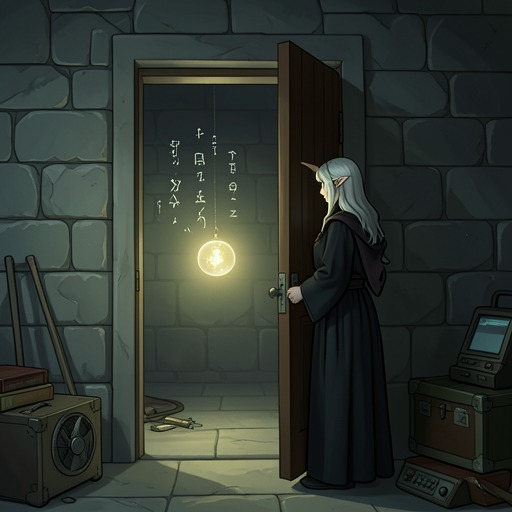
When Vivisari Vexaria encounters the door between bookshelves in the Institute library, its ordinary appearance conceals extraordinary defenses. She estimates that even she would need to exert herself to break through its enchantments, while the magic radiating from the wooden slab surpasses the defenses of the Convoy. The door has no sign or placard, leaving open the possibility that it is merely a staff entrance, a secret passage, or the threshold to the most restricted archives. Its unexplained presence transforms a familiar library into a boundary between ordinary scholarship and forbidden inheritance.
Inside, Vivisari Vexaria and Saffra meet a silvery ghost who resembles the portraits of former Headmasters. The ghost is Osmian, and his apparent survival is stranger than a conventional haunting. A crystallized Soul Fragment floats within his ethereal form, forming the core of a vessel whose existence is temporary. Osmian explains that the vessel has an expiration, which forces him to find an inheritor before it fails. His continued presence is therefore not immortality in the ordinary sense; it is a deliberately precarious extension of a divided consciousness.
Vivisari Vexaria immediately identifies the central problem. Splitting a soul without killing the original is already an astounding, though theoretically possible, accomplishment, but a fragment should not be able to survive outside the whole. Her question about how Osmian stabilized the fragment reveals the level at which she meets him: not as a reverent student confronting a relic, but as a mage capable of interrogating the mechanism of his existence. Osmian recognizes her knowledge of necromancy and treats the question as evidence that she can engage with the difficult foundations of his work.
The Succession Trials
Osmian’s purpose is to locate an inheritor who can receive his personal grimoires and become his apprentice after death. He has searched for a millennium and now fears that he may have to settle. His disgust suggests that the obstacle is not a lack of candidates but the impossibility of satisfying his standards. Even Archmage Lysander, the only known person to open the door before Vivisari Vexaria, apparently failed to qualify.
The trials test more than raw magical strength. In the final trial, Osmian requires Vivisari Vexaria to complete an enchantment without using her own mana, drawing the necessary energy from the flora of the island. The restriction turns the task into a trial of ritualism, demanding control, interpretation, and dependence on an external magical environment rather than the brute force available to a high-level mage. Osmian watches closely to determine whether her design is as impressive as it appears, retaining his skepticism even while acknowledging her unusual ability.
The result is a qualified rejection. Osmian concludes that Vivisari Vexaria is not suitable to call herself his apprentice or inherit his grimoires because their specialties diverge and her interest in ritualism is only superficial. The judgment does not erase her power; it distinguishes between general magical mastery and the particular discipline required for his inheritance. Vivisari Vexaria accepts the concession, and Osmian then agrees to a different arrangement: a conversation between peers.
Knowledge, Anomalies, and Intellectual Continuity
Osmian’s posthumous encounter with Vivisari Vexaria becomes valuable even after the succession fails. He permits an exception despite the limited lifespan of his vessel, teleports the group back to the office, and invites her questions while admitting that he has questions of his own. The exchange replaces inheritance with dialogue. His authority is no longer transmitted as a title or collection of grimoires; it becomes a working relationship centered on problems neither generation can safely ignore.
That intellectual continuity reaches beyond the hidden room. When Vivisari Vexaria later seeks Master Aeris’s help with dimensional magic, Aeris admits that the existence of such magic is certain and that preparation is necessary. The diagrams she sends have left the elites of the Institute excited and confused, revealing a knowledge community forced to confront concepts outside its established framework. Osmian represents the older foundation of that institution, while Vivisari Vexaria brings knowledge from a world and experience the current scholars cannot fully assimilate. The same pattern appears in the Institute’s response to the Dimensional Anomaly: Marcus initially dismisses the possibility that dimensions exist or that magic can interact with their boundaries, then concedes that the observed residual signature resembles exactly such an anomaly.
The contrast is especially important because Osmian’s inheritance is not treated as a dead archive. His door, soul vessel, grimoires, and trials preserve a living challenge to complacent scholarship. Yet his standards can also become sterile when they demand an inheritor whose abilities and interests perfectly match his own. Vivisari Vexaria’s failure exposes both sides of his legacy: he protects knowledge from unworthy hands, but he also risks making transmission impossible.
Narrative Significance and Continuing Legacy
Osmian’s importance lies in the way he turns institutional history into an encounter with unfinished consequences. The world celebrates the Party of Heroes because they defeated the seventh Cataclysm a century earlier, while Peace Day commemorates the population’s freedom from the terrors of the past. Yet the narrative repeatedly insists that safety is provisional: another Cataclysm may emerge, dimensional boundaries may crack, and unknown horrors may awaken. Osmian’s demand that Vivisari Vexaria study and prepare for dimensional magic places him within that forward-looking anxiety rather than allowing him to remain a figure of completed history.
His legacy also gains force from the later dimensional breach. Vivisari Vexaria determines that the breach is healing on its own because the dimensional boundary is resilient and self-repairing, although dangerous monsters continue to emerge into Meridian. The finding gives practical weight to the questions raised around Osmian’s research and to the Institute’s struggle to understand dimensional phenomena. What begins as a legendary door and a ghostly examination becomes part of the world’s necessary response to an otherworldly threat.
Osmian ultimately remains neither a conventional mentor nor a simple relic. He refuses Vivisari Vexaria the formal status of apprentice, yet recognizes her as an interesting peer and continues the exchange that matters more than ceremonial succession. His enduring function is to embody knowledge that survives death without becoming complete: guarded by impossible defenses, carried in a fragmentary vessel, tested through exacting rituals, and redirected into collaborative preparation for dangers that the established world still lacks the language to explain.